
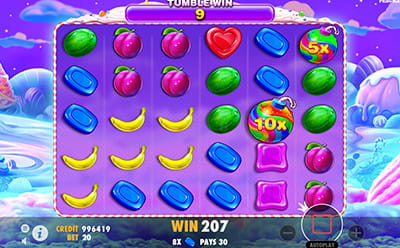
Sweet Bonanza practice mode can help Canadian players understand a slot’s controls and features before considering real-money play. The game’s cascading wins, Scatter symbols and Free Spins round are easier to follow after a few low-pressure sessions. An informational destination such as sweet bonanza casino may help readers identify where the game is discussed, but the hosting casino determines whether a free version is available. Practice credits have no cash value, and a demo session cannot confirm the exact settings, availability or terms of a particular operator’s real-money version.
What practice mode is actually useful for
Practice mode is primarily an orientation tool. It lets a player learn where the Spin button, stake controls, paytable, sound settings and game-history option appear without risking a deposit. The 6×5 layout remains visible, and the Pay Anywhere system can be observed in action. Instead of following fixed paylines, the game pays when at least eight matching symbols appear anywhere on the grid.
The Tumble mechanic is another feature worth learning before making any decision about real play. After a winning combination disappears, symbols above it drop into the empty spaces and new symbols arrive from the top. A single paid spin can therefore contain several separate wins. Practice play makes it easier to distinguish the original stake from later tumble results and to see when the sequence ends.
It is also useful for learning the difference between ordinary game features and casino promotions. Lollipop symbols act as Scatters, while four or more can trigger the built-in Free Spins feature. That is separate from promotional free spins offered by a casino. A demo session can show how the game works, but it cannot establish whether an operator offers a promotion, which terms apply or whether a particular feature is enabled.
Use a short session to learn the controls
A focused session is more informative than repeatedly pressing Spin without a purpose. Begin by opening the information screen and checking the displayed rules, available stake choices and the RTP configuration shown for that version. The published settings can differ between operators, so the information screen in the loaded game is more relevant than a generic figure found elsewhere.
Next, test the interface rather than chasing a particular result. Adjust the stake, open the paytable, check the game-history function and identify how the game signals a win. If sound or animation makes the screen difficult to follow, change those settings before continuing. On some implementations, Quick Spin or Autoplay may be present, but these options can make individual tumbles harder to observe.
A simple learning sequence can keep the session practical:
- Read the symbol values and Scatter requirements.
- Watch one complete tumble sequence from the initial win to its finish.
- Open the rules again after seeing a feature and compare what happened with the written explanation.
- Check whether Free Spins begin with 10 spins and how additional Scatters affect the total.
- Close the session once the controls and terminology are familiar.
This approach treats practice mode as a product tour, not as a prediction exercise. It also avoids confusing familiarity with evidence that future spins will behave in a particular way.
Which features deserve closer attention?

The ordinary symbols are straightforward, but the win structure deserves attention because matching symbols do not need to sit beside one another in a conventional line. Eight or nine matching symbols form the lowest qualifying combination, with larger awards for 10–11 and 12 or more. Multiple wins within one tumble are added before the next cascade begins.
The Free Spins round has additional moving parts. In the original documented version, four, five or six lollipop Scatters can provide a direct Scatter payout and trigger the feature. The round normally starts with 10 free spins, while three or more additional Scatters award five extra spins. Practice mode can help a player follow these changes without having to interpret them for the first time during a paid session.
Multiplier bombs appear only during Free Spins in the original version. Each may carry a value from 2x to 100x, and bombs remain on the grid until the current tumble finishes. Their values are then added together before the resulting multiplier is applied to that tumble’s win. This timing matters: the multiplier is not simply applied immediately to every symbol as it lands. Rules can vary by game version, so the loaded information screen remains the final reference.
What practice play cannot prove
Demo results cannot demonstrate that a game is due to pay, that a particular strategy improves outcomes or that a short session reflects long-term performance. Random results can include several wins, long dry spells or an unusually large feature in any mode. None of those outcomes provides a forecast for the next spin. Practice is therefore best used to understand operation, not to test a supposed winning system.
It also cannot verify every real-money condition. The casino may use a different RTP configuration, stake range or feature availability. The documented original version has published RTP configurations around 96.48%–96.51%, but that range should not be assumed to apply everywhere. The exact value displayed in the active game, together with the operator’s terms, is the information that matters.
Practice mode may also omit account-level controls. Deposits, withdrawals, verification, bonus restrictions, loss limits, session reminders and self-exclusion are handled by the casino rather than by the slot. Availability can differ by province, operator and account. Before switching to real-money play, a reader should check the casino’s stated requirements, confirm the relevant rules and decide on a fixed entertainment budget. No demo result justifies increasing that budget.
When should you stop practising and reassess?
There is no required number of demo spins. Stop when you can explain the basic controls, identify the Scatter and understand how a tumble ends. Continuing solely to wait for a large win changes the purpose of practice mode. It can encourage the mistaken belief that persistence improves the odds or that a feature is becoming more likely after ordinary spins.
It is sensible to reassess if the interface is unclear, the rules cannot be opened or the displayed information conflicts with an external description. Different titles can look similar, including later products with related names. Confirm that the loaded game is the original version before relying on details such as the 6×5 grid, the 10-spin starting feature or the Bonus Buy description.
Anyone considering real-money play should make the transition a separate decision, not an automatic next step. Check the operator’s age, identity and account requirements, as well as the applicable game terms. Review whether the casino provides deposit, loss or session controls, and decide in advance what amount and time limit are acceptable. If practice stops feeling educational and starts feeling urgent, ending the session is the more useful choice.
Sweet Bonanza practice mode questions
Does practice mode use real money?
No. A free-demo version uses virtual credits and does not create withdrawable winnings. Availability depends on the website hosting the game. Real-money play requires an account with the selected casino, whose deposit, verification and withdrawal rules are separate from the slot’s built-in features.
Can practice mode confirm the RTP?
No. Short-term demo results cannot verify RTP or predict future outcomes. The relevant RTP is the configuration displayed in the active game’s information screen. Operators may offer different configurations, so published figures should be treated as general information rather than confirmation of a specific casino version.
Does practising improve the chance of winning?
No. Practice can improve familiarity with controls, symbols and tumble timing, but it does not alter random outcomes or create a profitable strategy. It is useful for deciding whether the interface is understandable and suitable for entertainment, not for forecasting results or proving that a game is favourable.